
Hothouse Flowers Get a Jump on Spring
A Small Farm in LaGrangeville Produces Big Results
By Tara Kelly
Photos by Rana Faure
Jennifer Kouvant describes herself and her husband, Hans Li, as accidental farmers. “Life is a book with one chapter leading to the next,” she says. “I never thought as a child that I would be a farmer.”
In this chapter, Kouvant and Li have transformed a small horse farm on 12 acres in Clove Valley into a flower farm that produces blooms year-round. In Dutchess County—where this past winter snow measured in feet and temperatures dipped below zero—how does that work?
Over time, for starters. Add Li’s background as an architect, a shared commitment to land stewardship, high dedication, and a learn-as-you-go approach, and the picture comes into focus.
The farm, which Li purchased in 2001, has multiple barns, a large indoor arena, and several run-in sheds. He named it Six Dutchess Farm, a nod to the six horses that once lived there. Unfortunately, Jennifer was highly allergic, so they set about reimagining the property’s use.
“The first step was chickens,” says Kouvant. Then they brought in Gotland sheep. “My mother is Danish,” she explains. “We do rotational grazing, which is gentler on the land. They get shorn twice a year, and we sell the wool.” About seven years ago, they planted their first dahlias.
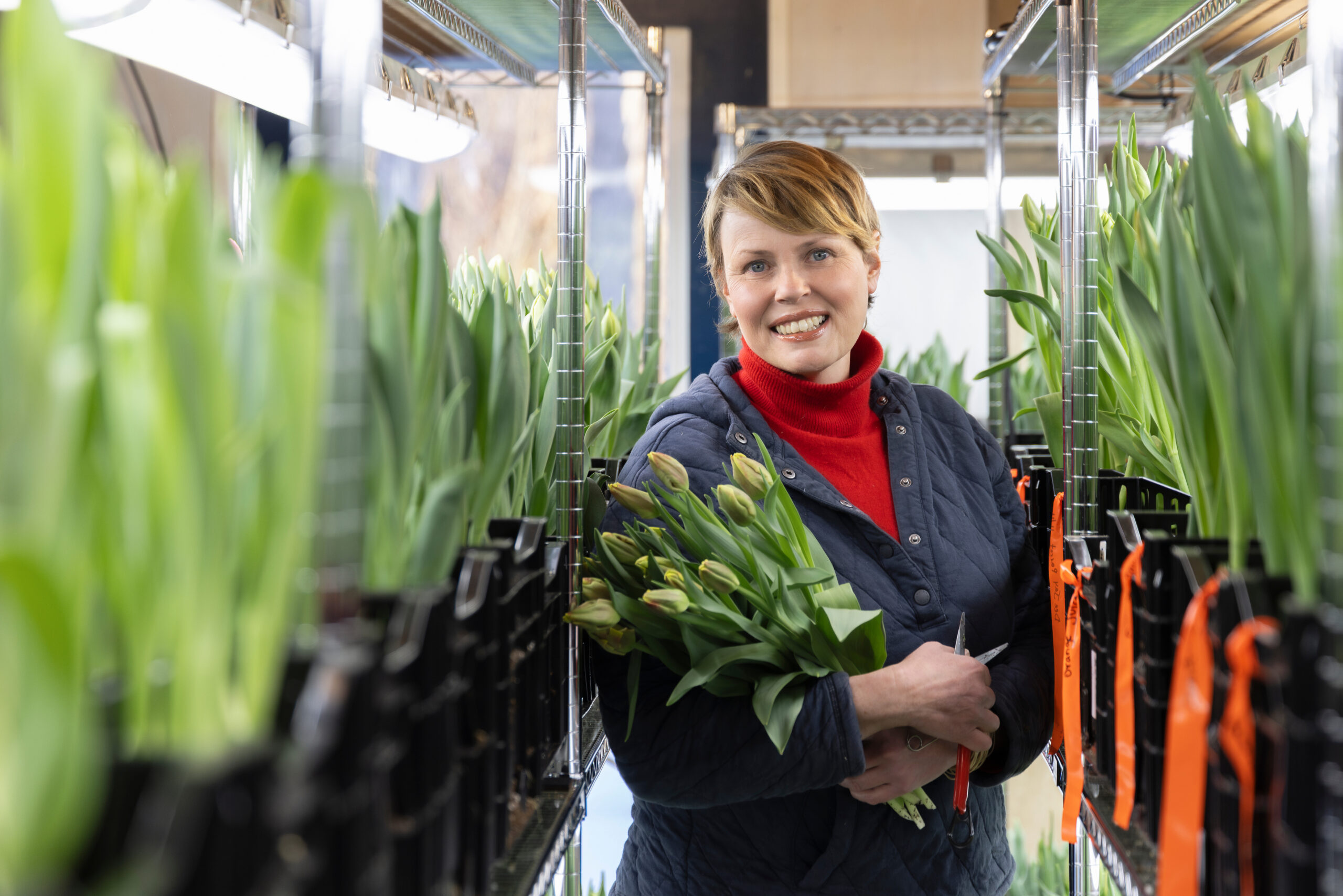
“That was our first floral attempt. Then we added field tulips. About three years ago, we started growing winter tulips,” Kouvant says. To make this possible, Li converted a former duck house—already equipped with radiant floor heat—into a temperature-controlled building. They continue to transform farm structures into revenue-generating spaces.
“It’s the flowers that allow us to run a business on a small footprint. We have a great market here. We grow tulips for over five months of the year, and all our early spring flowers are grown indoors—hundreds of thousands of blooms annually. We can grow 20,000 flowers in a single enclosure.”
“Our signature flowers are winter tulips. They’re a big part of our production. We start selling them from late January to early April, then move to field tulips. They don’t like heat, so production usually ends by mid-May.”

Their second signature flower is lisianthus. “We grow almost 60 varieties in high tunnels, which are basically unheated greenhouses—big hoops covered with double layers of plastic. In thishistoric cold, we also put row covers on the plants set to bloom in late March and April,” Kouvant says.
They’re also starting summer flowers: snapdragons, delphiniums, Icelandic jumbo poppies, and campanula in the high tunnels. Fall will bring dahlias and heirloom chrysanthemums.
Kouvant and Li are planning events to introduce people to their farm. “Small farms only exist because of their connection to the community,” Kouvant says. “We want people to experience small farm life and see where their products come from.”
—SixDutchessFarm.com
